
October 10, 2026
Quick answer, if you’re in a hurry: go hybrid for kitchens, bathrooms, laundries, or if you’ve got kids and pets running amok. Laminate can still make sense for a dry bedroom or a low-traffic room, if budget’s tight. Now here’s why.
We get asked this one constantly. Someone’s been scrolling flooring websites for a week, every product photo looks basically the same; timber-look planks, click-together edges, similar price range; and they can’t work out why one costs more than the other, or whether it even matters.
It matters. Not because one is “better” in some universal sense, but because they’re built differently underneath, and that difference shows up the first time you mop the kitchen floor or your dog has an accident on it.
So what's actually different?
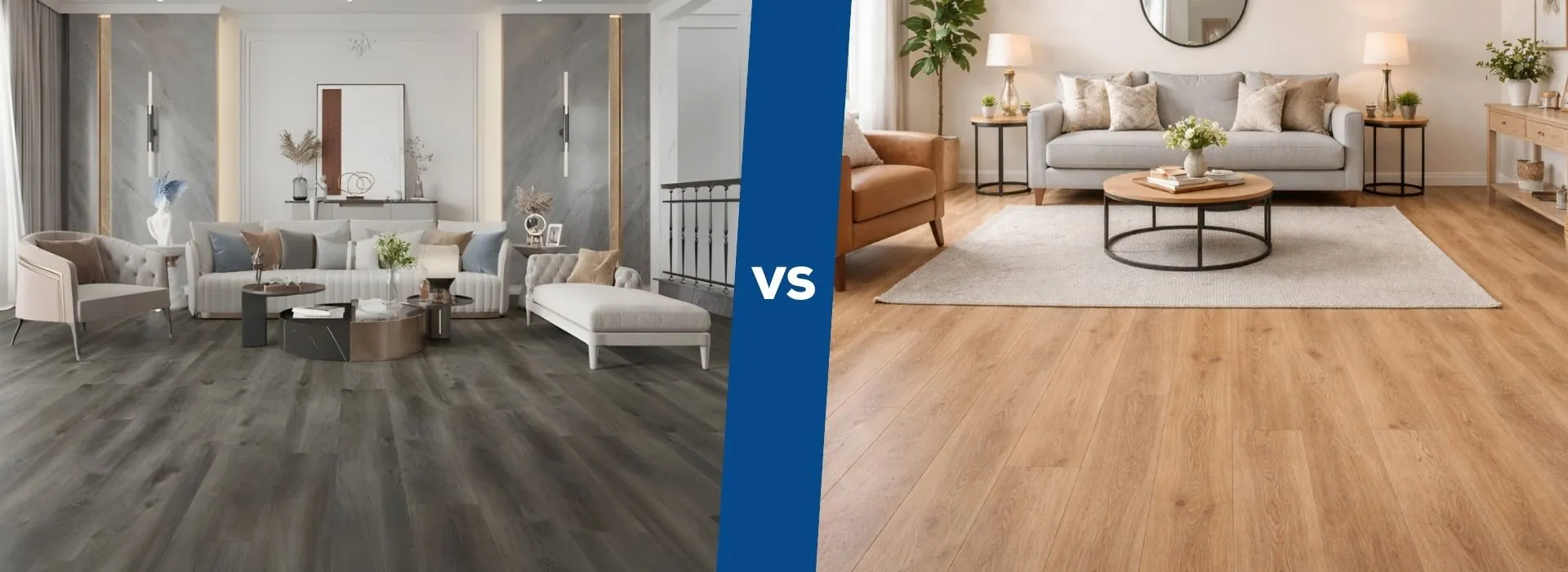
Both are floating floors. Both click together without glue or nails. Both have a printed layer on top that mimics timber grain, so from a metre away they can be hard to tell apart. The whole difference lives in the core, the layer you never see once it’s installed.
That’s it, really, one sentence explains most of the debate. Laminate’s core is made from compressed wood fibre, so if water sits on a seam for too long, it swells and the boards start to lift or peak at the joints. Hybrid’s core is a plastic-based composite, so water just sits on top until you wipe it up. No swelling, no drama.
Hybrid - Rigid SPC/WPC core
– Stone-plastic or wood-plastic composite
– Doesn’t absorb water, won’t swell
– Stable through temperature swings
– Firmer, more solid feel underfoot
Laminate - HDF wood-fibre core
– Compressed wood fibre board
– Swells if water gets past the surface
– Can be sensitive to humidity
– Slightly hollow “clack” underfoot
Which one for which room?
Rather than declaring an overall winner (there isn’t one, it depends on the room), here’s how we’d actually walk you through your own house.
Kitchen
Spills, dishwasher leaks, mopping; happens weekly, sometimes daily.
Go hybrid
Bathroom & laundry
Consistently wet. Laminate genuinely isn’t designed for this environment.
Go hybrid
Bedrooms
Dry, low moisture risk, lower foot traffic. Laminate does the job fine here.
Laminate is okay
Formal lounge
Rarely used, rarely spilled on. If budget’s the priority, laminate holds up.
Either works
Homes with pets
Accidents happen, claws scratch. Hybrid’s tougher wear layer and waterproof core forgive more.
Go hybrid
Whole-home consistency
Most people just pick hybrid throughout so every room matches and nothing’s off-limits for spills.
Go hybrid
Still torn between the two?
Bring both to your kitchen table, literally. We’ll bring hybrid and laminate samples to your home so you can see and feel the difference yourself, no showroom trip required.
The head-to-head
If you want it laid out plainly, here’s the full comparison. We’ve included engineered timber and vinyl too, since they often come up in the same conversation.
What about cost?
Here’s the bit people expect to be a big gap, and honestly, it’s often closer than you’d think. Supply and installation for both hybrid and standard laminate typically starts from around $50 per m², they sit in a pretty similar budget-to-mid-range bracket. Where the cost story really changes is if you go for something like a herringbone pattern in hybrid, which involves more cutting and takes longer to lay, so that starts from around $79 per m² instead.
The number that matters more than the sticker price, though, is the cost of getting it wrong. A laminate floor that swells from water damage usually needs replacing, and that’s a second install on top of the first. That’s less a hybrid-vs-laminate argument and more a “know what room you’re putting it in” argument. Either way, the only way to get a figure that actually applies to your home is a free in-home measure and quote, and because Jim’s Flooring carries stock, you’re not stuck waiting weeks on a supplier once you’ve decided.
Our honest take
If we’re being straight with you: for most Australian homes, hybrid has become the safer default. It costs roughly the same as laminate in a lot of cases, handles the rooms laminate can’t, and you don’t have to think twice about where it goes in the house. That’s not us pushing the pricier option, hybrid and laminate often land at a similar price point, so there’s not much financial incentive either way. It’s just what tends to hold up better over ten years of actual family life.
That said, laminate isn’t a bad floor. It’s not “cheap and nasty”, it’s simply built for dry rooms, and in a dry room it does exactly what it’s meant to. If you’re flooring a formal lounge that sees a handful of visitors a year, there’s no need to overspend on waterproofing you’ll never use.
Want a second opinion that’s specific to your actual floor plan? That’s what the free in-home visit is for, we’ll walk the rooms with you and tell you honestly where we’d go hybrid and where laminate would do just fine.